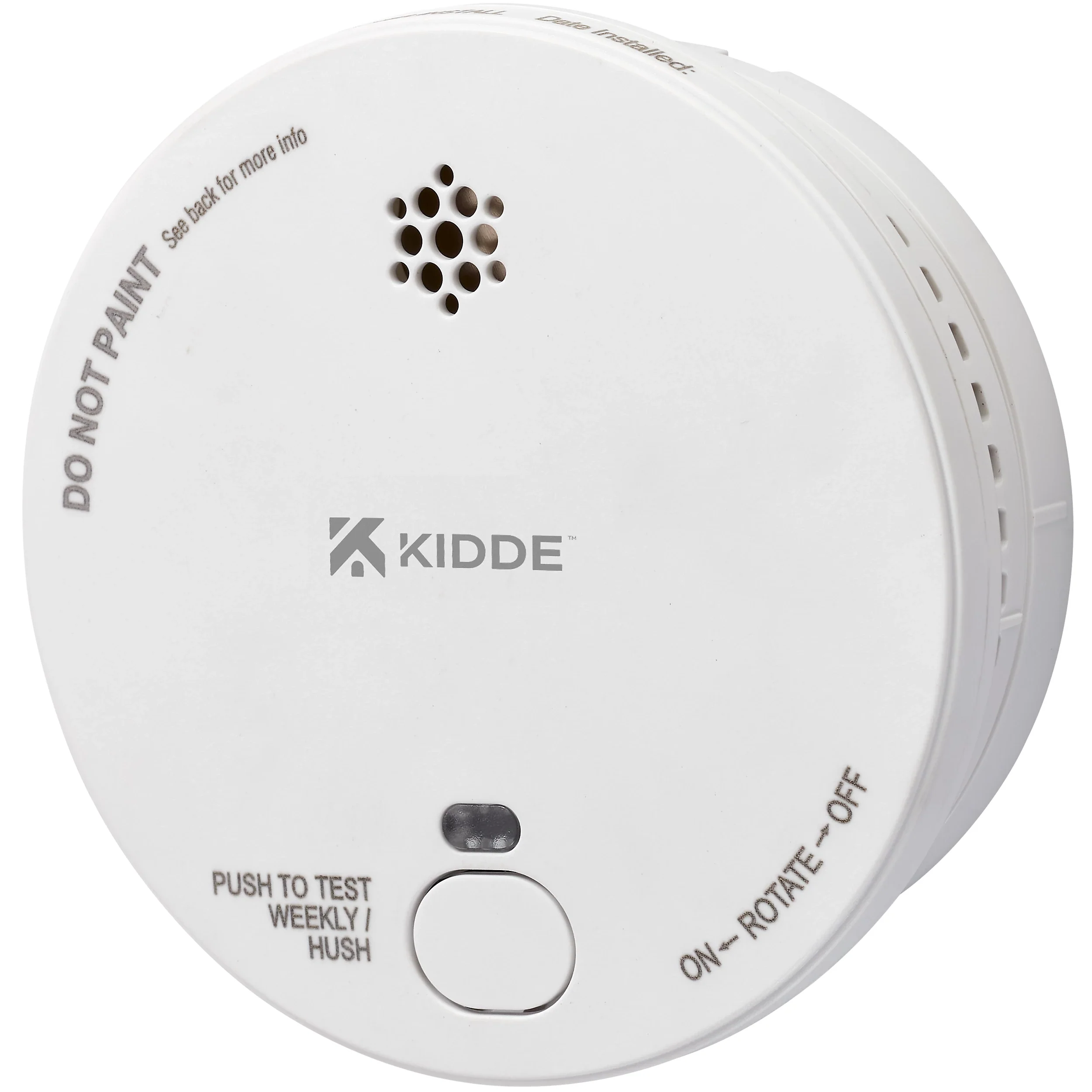
Kidde 2030-DSR Standalone Optical Smoke Alarm with Replaceable battery | 2030-DSR
Product Description
The Kidde 2030-DSR battery-powered smoke alarm ensures reliable fire detection with its advanced optical sensor. It is ideal for detecting slow-burning fires, and includes a ‘hush’ control feature that allows nuisance alarms (such as those caused by cooking or steam) to be temporarily silenced. Its compact design fits easily in any room, offering essential safety for homes, flats, and small offices.
- Guarantee - 3 years
- Battery included
- Fittings & fixings included
- Equipped with hush button
- Ideal for general use, this standalone product meets standard safety requirements but is not intended for use where interlinked alarm compliance is required (e.g. Scotland or UK private rented.
Features and benefits
- Optical sensor technology
- Hush feature allows nuisance alarms to be temporarily silenced
- Requires a standard 9V (PP3) battery
Specifications
| Alarm test function | Single button test & silence function |
|---|---|
| Battery back-up | Without battery back-up |
| Battery chemistry | Alkaline |
| Battery name | PP3 (6LR61) |
| Brand | Kidde |
| Current type | DC |
| Height (mm) | 36mm |
| Interlinked smoke alarms | Standalone |
| LED indicator | With LED indicator |
| Location | Internal |
| Noise level | 85dB(A) |
| Number of batteries included | 1 |
| Number of batteries required | 1 |
| Pack quantity | 1 |
| Power indicator | With power indicator |
| Power source | Battery-powered |
| Power voltage supply | Not mains fed |
| Standard | EN 14604:2005 |
| Weight (g) | 125g |
| Wireless | Wireless |
| Product code | 0047871314041 |
Safety Information
WARNING: Ten (10) years after initial power up, this unit will automatically alert you that it is time to replace the alarm.
Warning: please read carefully and thoroughly Life safety from fire in residential occupancies is based primarily on early notification to occupants of the need to escape, followed by the appropriate egress actions by those occupants. Fire warning systems for dwelling units are capable of protecting about half of the occupants in potentially fatal fires. An alarm may not be effective in some situations, such as during incendiary fires where the fire grows so rapidly that an occupant’s egress is blocked even with properly located alarms, or when victims are intimate with the fire (for example, when a person’s clothes catch fire while cooking), too old or young, or physically or mentally impaired such that they cannot escape even when warned early enough that escape should be possible. For these people, additional strategies such as protection-in-place or assisted escape or rescue are necessary. There are situations where a smoke alarm may not be effective to protect against fire. For instance: a) smoking in bed b) leaving children home alone c) cleaning with flammable liquids, such as petrol A battery powered alarm must have a battery of the specified type, in good condition and installed properly. Smoke alarms must be tested regularly to make sure the battery and the alarm circuits are in good operating condition. Smoke alarms cannot provide an alarm if smoke does not reach the alarm. Therefore, smoke alarms may not sense fires starting in chimneys, walls, on roofs, on the other side of a closed door or on a different floor. If the alarm is located outside the bedroom or on a different floor, it may not wake up a sound sleeper. The use of alcohol or drugs may also impair one’s ability to hear the smoke alarm. For maximum protection, a smoke alarm should be installed in each sleeping area on every level of a home. This alarm is not intended to alert hearing impaired individuals.
WARNING: To reduce the risk of fire or electric shock, do not expose this product to rain or moisture.
WARNING: Alarm will not attach to mounting bracket unless battery is installed. Removal of battery will render the unit inoperative. WARNING! Use only the batteries specified. Use of different batteries may have a detrimental effect on the smoke alarm.
WARNING: Ten (10) years after initial power up, this unit will automatically alert you that it is time to replace the alarm.
Warning: please read carefully and thoroughly Life safety from fire in residential occupancies is based primarily on early notification to occupants of the need to escape, followed by the appropriate egress actions by those occupants. Fire warning systems for dwelling units are capable of protecting about half of the occupants in potentially fatal fires. An alarm may not be effective in some situations, such as during incendiary fires where the fire grows so rapidly that an occupant’s egress is blocked even with properly located alarms, or when victims are intimate with the fire (for example, when a person’s clothes catch fire while cooking), too old or young, or physically or mentally impaired such that they cannot escape even when warned early enough that escape should be possible. For these people, additional strategies such as protection-in-place or assisted escape or rescue are necessary. There are situations where a smoke alarm may not be effective to protect against fire. For instance: a) smoking in bed b) leaving children home alone c) cleaning with flammable liquids, such as petrol A battery powered alarm must have a battery of the specified type, in good condition and installed properly. Smoke alarms must be tested regularly to make sure the battery and the alarm circuits are in good operating condition. Smoke alarms cannot provide an alarm if smoke does not reach the alarm. Therefore, smoke alarms may not sense fires starting in chimneys, walls, on roofs, on the other side of a closed door or on a different floor. If the alarm is located outside the bedroom or on a different floor, it may not wake up a sound sleeper. The use of alcohol or drugs may also impair one’s ability to hear the smoke alarm. For maximum protection, a smoke alarm should be installed in each sleeping area on every level of a home. This alarm is not intended to alert hearing impaired individuals.
WARNING: To reduce the risk of fire or electric shock, do not expose this product to rain or moisture.
WARNING: Alarm will not attach to mounting bracket unless battery is installed. Removal of battery will render the unit inoperative. WARNING! Use only the batteries specified. Use of different batteries may have a detrimental effect on the smoke alarm.
WARNING: Ten (10) years after initial power up, this unit will automatically alert you that it is time to replace the alarm.
Warning: please read carefully and thoroughly Life safety from fire in residential occupancies is based primarily on early notification to occupants of the need to escape, followed by the appropriate egress actions by those occupants. Fire warning systems for dwelling units are capable of protecting about half of the occupants in potentially fatal fires. An alarm may not be effective in some situations, such as during incendiary fires where the fire grows so rapidly that an occupant’s egress is blocked even with properly located alarms, or when victims are intimate with the fire (for example, when a person’s clothes catch fire while cooking), too old or young, or physically or mentally impaired such that they cannot escape even when warned early enough that escape should be possible. For these people, additional strategies such as protection-in-place or assisted escape or rescue are necessary. There are situations where a smoke alarm may not be effective to protect against fire. For instance: a) smoking in bed b) leaving children home alone c) cleaning with flammable liquids, such as petrol A battery powered alarm must have a battery of the specified type, in good condition and installed properly. Smoke alarms must be tested regularly to make sure the battery and the alarm circuits are in good operating condition. Smoke alarms cannot provide an alarm if smoke does not reach the alarm. Therefore, smoke alarms may not sense fires starting in chimneys, walls, on roofs, on the other side of a closed door or on a different floor. If the alarm is located outside the bedroom or on a different floor, it may not wake up a sound sleeper. The use of alcohol or drugs may also impair one’s ability to hear the smoke alarm. For maximum protection, a smoke alarm should be installed in each sleeping area on every level of a home. This alarm is not intended to alert hearing impaired individuals.
WARNING: To reduce the risk of fire or electric shock, do not expose this product to rain or moisture.
WARNING: Alarm will not attach to mounting bracket unless battery is installed. Removal of battery will render the unit inoperative. WARNING! Use only the batteries specified. Use of different batteries may have a detrimental effect on the smoke alarm.
Original: $17.61
-65%$17.61
$6.16Product Information
Product Information
Shipping & Returns
Shipping & Returns
Description
Product Description
The Kidde 2030-DSR battery-powered smoke alarm ensures reliable fire detection with its advanced optical sensor. It is ideal for detecting slow-burning fires, and includes a ‘hush’ control feature that allows nuisance alarms (such as those caused by cooking or steam) to be temporarily silenced. Its compact design fits easily in any room, offering essential safety for homes, flats, and small offices.
- Guarantee - 3 years
- Battery included
- Fittings & fixings included
- Equipped with hush button
- Ideal for general use, this standalone product meets standard safety requirements but is not intended for use where interlinked alarm compliance is required (e.g. Scotland or UK private rented.
Features and benefits
- Optical sensor technology
- Hush feature allows nuisance alarms to be temporarily silenced
- Requires a standard 9V (PP3) battery
Specifications
| Alarm test function | Single button test & silence function |
|---|---|
| Battery back-up | Without battery back-up |
| Battery chemistry | Alkaline |
| Battery name | PP3 (6LR61) |
| Brand | Kidde |
| Current type | DC |
| Height (mm) | 36mm |
| Interlinked smoke alarms | Standalone |
| LED indicator | With LED indicator |
| Location | Internal |
| Noise level | 85dB(A) |
| Number of batteries included | 1 |
| Number of batteries required | 1 |
| Pack quantity | 1 |
| Power indicator | With power indicator |
| Power source | Battery-powered |
| Power voltage supply | Not mains fed |
| Standard | EN 14604:2005 |
| Weight (g) | 125g |
| Wireless | Wireless |
| Product code | 0047871314041 |
Safety Information
WARNING: Ten (10) years after initial power up, this unit will automatically alert you that it is time to replace the alarm.
Warning: please read carefully and thoroughly Life safety from fire in residential occupancies is based primarily on early notification to occupants of the need to escape, followed by the appropriate egress actions by those occupants. Fire warning systems for dwelling units are capable of protecting about half of the occupants in potentially fatal fires. An alarm may not be effective in some situations, such as during incendiary fires where the fire grows so rapidly that an occupant’s egress is blocked even with properly located alarms, or when victims are intimate with the fire (for example, when a person’s clothes catch fire while cooking), too old or young, or physically or mentally impaired such that they cannot escape even when warned early enough that escape should be possible. For these people, additional strategies such as protection-in-place or assisted escape or rescue are necessary. There are situations where a smoke alarm may not be effective to protect against fire. For instance: a) smoking in bed b) leaving children home alone c) cleaning with flammable liquids, such as petrol A battery powered alarm must have a battery of the specified type, in good condition and installed properly. Smoke alarms must be tested regularly to make sure the battery and the alarm circuits are in good operating condition. Smoke alarms cannot provide an alarm if smoke does not reach the alarm. Therefore, smoke alarms may not sense fires starting in chimneys, walls, on roofs, on the other side of a closed door or on a different floor. If the alarm is located outside the bedroom or on a different floor, it may not wake up a sound sleeper. The use of alcohol or drugs may also impair one’s ability to hear the smoke alarm. For maximum protection, a smoke alarm should be installed in each sleeping area on every level of a home. This alarm is not intended to alert hearing impaired individuals.
WARNING: To reduce the risk of fire or electric shock, do not expose this product to rain or moisture.
WARNING: Alarm will not attach to mounting bracket unless battery is installed. Removal of battery will render the unit inoperative. WARNING! Use only the batteries specified. Use of different batteries may have a detrimental effect on the smoke alarm.
WARNING: Ten (10) years after initial power up, this unit will automatically alert you that it is time to replace the alarm.
Warning: please read carefully and thoroughly Life safety from fire in residential occupancies is based primarily on early notification to occupants of the need to escape, followed by the appropriate egress actions by those occupants. Fire warning systems for dwelling units are capable of protecting about half of the occupants in potentially fatal fires. An alarm may not be effective in some situations, such as during incendiary fires where the fire grows so rapidly that an occupant’s egress is blocked even with properly located alarms, or when victims are intimate with the fire (for example, when a person’s clothes catch fire while cooking), too old or young, or physically or mentally impaired such that they cannot escape even when warned early enough that escape should be possible. For these people, additional strategies such as protection-in-place or assisted escape or rescue are necessary. There are situations where a smoke alarm may not be effective to protect against fire. For instance: a) smoking in bed b) leaving children home alone c) cleaning with flammable liquids, such as petrol A battery powered alarm must have a battery of the specified type, in good condition and installed properly. Smoke alarms must be tested regularly to make sure the battery and the alarm circuits are in good operating condition. Smoke alarms cannot provide an alarm if smoke does not reach the alarm. Therefore, smoke alarms may not sense fires starting in chimneys, walls, on roofs, on the other side of a closed door or on a different floor. If the alarm is located outside the bedroom or on a different floor, it may not wake up a sound sleeper. The use of alcohol or drugs may also impair one’s ability to hear the smoke alarm. For maximum protection, a smoke alarm should be installed in each sleeping area on every level of a home. This alarm is not intended to alert hearing impaired individuals.
WARNING: To reduce the risk of fire or electric shock, do not expose this product to rain or moisture.
WARNING: Alarm will not attach to mounting bracket unless battery is installed. Removal of battery will render the unit inoperative. WARNING! Use only the batteries specified. Use of different batteries may have a detrimental effect on the smoke alarm.
WARNING: Ten (10) years after initial power up, this unit will automatically alert you that it is time to replace the alarm.
Warning: please read carefully and thoroughly Life safety from fire in residential occupancies is based primarily on early notification to occupants of the need to escape, followed by the appropriate egress actions by those occupants. Fire warning systems for dwelling units are capable of protecting about half of the occupants in potentially fatal fires. An alarm may not be effective in some situations, such as during incendiary fires where the fire grows so rapidly that an occupant’s egress is blocked even with properly located alarms, or when victims are intimate with the fire (for example, when a person’s clothes catch fire while cooking), too old or young, or physically or mentally impaired such that they cannot escape even when warned early enough that escape should be possible. For these people, additional strategies such as protection-in-place or assisted escape or rescue are necessary. There are situations where a smoke alarm may not be effective to protect against fire. For instance: a) smoking in bed b) leaving children home alone c) cleaning with flammable liquids, such as petrol A battery powered alarm must have a battery of the specified type, in good condition and installed properly. Smoke alarms must be tested regularly to make sure the battery and the alarm circuits are in good operating condition. Smoke alarms cannot provide an alarm if smoke does not reach the alarm. Therefore, smoke alarms may not sense fires starting in chimneys, walls, on roofs, on the other side of a closed door or on a different floor. If the alarm is located outside the bedroom or on a different floor, it may not wake up a sound sleeper. The use of alcohol or drugs may also impair one’s ability to hear the smoke alarm. For maximum protection, a smoke alarm should be installed in each sleeping area on every level of a home. This alarm is not intended to alert hearing impaired individuals.
WARNING: To reduce the risk of fire or electric shock, do not expose this product to rain or moisture.
WARNING: Alarm will not attach to mounting bracket unless battery is installed. Removal of battery will render the unit inoperative. WARNING! Use only the batteries specified. Use of different batteries may have a detrimental effect on the smoke alarm.